Maryland Voices of the Civil War
No state better exemplified the vital and complex role of the border slave state than Maryland. Maryland Voices of the Civil War uses the lens of the civilian experience to examine the animating themes of the state’s Civil War story: suspension of the writ of habeas corpus, the fate of civil liberties in wartime, military operations, and how enslaved people in Maryland fled and fought to attain their own freedom, six months before Lee’s surrender at Appomattox.
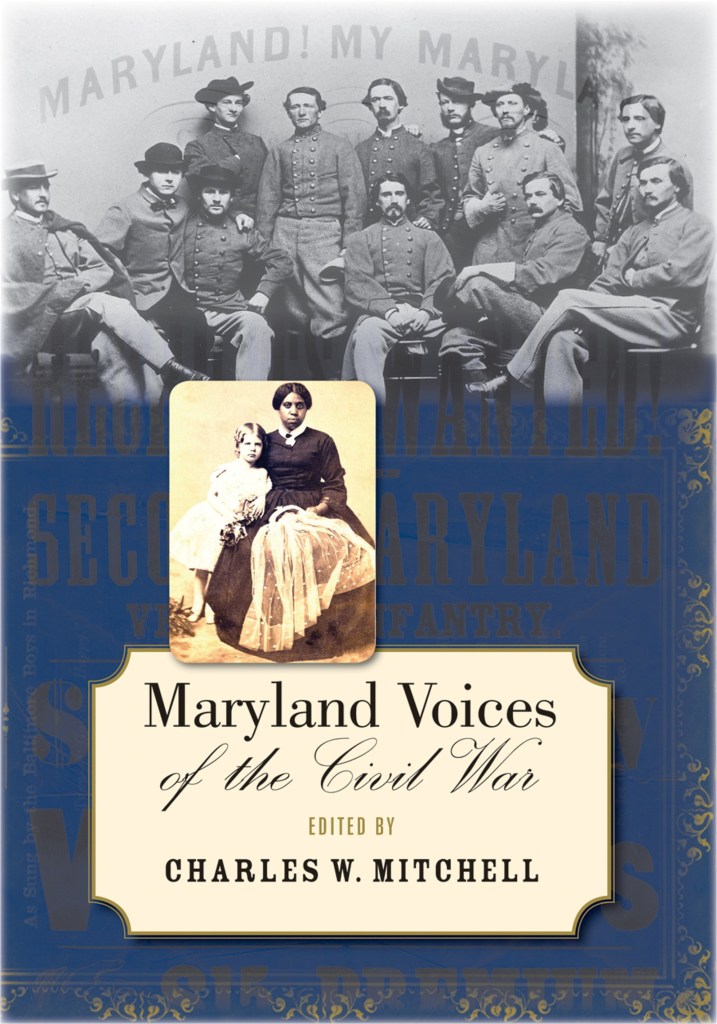
I marshal the evidence that Maryland’s southern sympathies, while genuine, never seriously threatened secession from the Union. The book won the American Civil War Museum’s Founders Award, chosen from 19 entrants.
Maryland Voices relies on more than a thousand letters, diaries, period newspapers and images—many previously unpublished—to portray the passions of merchants, soldiers, women, politicians, freemen, clergy, children, enslaved people and their owners—caught in the fear, anger and violence of war. Headnotes introduce each document, offering readers context about its writer, its significance or its recipient.
From the Book: Marylanders Speak:
Just after the April 19, 1861, Pratt Street Riot in Baltimore, when a mob clashed with Massachusetts militia passing through the city en route to Washington, one Shriver cousin wrote to another: “The Cry at 11-1/2 O’clock was, that there were at Cockeysville some 4000 armed troops ready to make an attack upon the City…John and I were on our way to church at the time, and not having arms of any kind thought perhaps it was as good a place as one could get…when we got into the Church and saw how deathlike the silence was, and how much affected all the ladies were—I tell you I felt mighty badly. We had no music—and as the service was very short we were soon through.” (page 65)
Elizabeth Patterson Bonaparte, married to Napoleon Bonaparte’s younger brother Jerome and living in Paris, employed a manager for her properties in Baltimore. He wrote to her in May 1861: “We are so fully engaged in war here that all business is well nigh suspended, indeed since April 19th the general fear has been that our City would be burned up…I am sorry to say that on that same day 2 of your houses came near being in ruins.” (page 94)
A pacifist wrote “I do not feel like taking any part in the fight as I cannot bear the Idea of hurting any of my fellow beings…if they get to fighting here I will leave and go somewhere North I have kept my boys out of it up to this time and if I can I will continue to keep them from fighting.” (page 105)
Anne Schaeffer of Frederick, Maryland, described the scene in early September 1862 when word arrived that the Confederate army was expected to move through the town, en route to what would be the September 19 Battle of Antietam: “We were startled by the cry of “Fire! Fire!” then we heard the fire bells ringing—the given signal of the approach of the enemy. No tongue or pen can describe our emotions…confident that [my husband’s] drug store would be ransacked my Husband had the most valuable articles brought home, where we hid them away, covered from view by ashes under an old fashioned outdoor bakeoven and not knowing what we might be called upon to endure the coming day, we lay down to rest after midnight and slept until 5 O’clock.” (page 308)
Schaeffer recorded the arrival of large numbers of soldiers wounded in the battle: “All day [Saturday] in the kitchen preparing broth, porridge and jelly for the wounded…a lovely Sabbath day [Sunday}—but it does not appear like the Sabbath. Churches filled with the wounded and dying, streets thronged with ladies and servants carrying baskets and buckets…strangers going the rounds to find friends.” (page 173)
Some young Frederick ladies accepted invitations from the dashing Rebel Gen. Jeb Stuart to an impromptu ball: “As the delightful strains of music floated through the vacant house, and the dancing began, the strange accompaniments of war added zest to the occasion…just as everything had become well started and the enjoyment of the evening was at its height, there came shivering through the still night air the boom of artillery, followed by the angry rattle of musketry. The lily chased the rose from the cheek of beauty, and every pretty foot was rooted to the floor where music had left it. Then came hasty and tender partings from tearful partners, buckling on of sabers, mounting of impatient steeds, and clattering of hoofs as the gay cavaliers dashed off.” (page 312)
John Greenleaf Whittier immortalized Frederick’s Barbara Frietchie in his poem of the same name. Stonewell Jackson staff officer Henry Kyd Douglas backed other accounts that Jackson’s men did not pass by her home: “We did not pass her house. There was such an old woman in Frederick, in her ninety-sixth year and bedridden. She never saw Stonewall Jackson and he never saw her. I was with him every minute when he was in the town, and nothing like the patriotic incident so graphically described by Mr. Whittier in his poem ever occurred.” (page 317)
William Birney, overseeing recruitment of Black men for the U.S. Bureau of Colored Troops, responded to a slave owner who complained that “his” enslaved man had been coerced into enlisting: “No slaves whatever have been mustered by me against their will; and no free persons. Every person prior to muster has full opportunity to say whether or not he will enter the service. I do not keep my recruits under guard…nine owners out of ten will insist upon it that their slaves are much attached to them and would not leave them unless enticed or forced away. My conviction is that this is a delusion. I have yet to see a slave of this kind. If their families could be cared for or taken with them, the whole slave population of Maryland would make its exodus to Washington.” (page 417)
Prominent Unionist Leonidas Dodson of Easton, on Maryland’s Eastern Shore, rejoiced at the news “that Richmond, the rebel Capital, for four dreary years the nest of traitors…has fallen. Easton has been in the wildest excitement all evening, the Court House, and Church bells have rung, cannon jars the earth, bonfires blaze, and illuminations prevail. Even the disloyal seem to experience a kind of sympathy with the general jubilation.” (page 456)
A Baltimore newspaper described the excitement in the city: “It is impossible to describe the earnest and fervent enthusiasm evoked in Baltimore yesterday by the announcement of the capture of Richmond. The glorious news ran lie wildfire through the city, and from all sections the masses came pouring by the thousands on to Baltimore street. The people were wild…an irrepressible enthusiasm animated our citizens, and again and again cheers broke out for the President, Gen. Grant, and the army…a dense mass packed the square from North to Calvert street, scarcely moving for hours, and listening with remarkable attention to the speakers. Altogether the day was such a one as rarely occurs twice in the experience of a lifetime.” (page 457)
Praise for Maryland Voices of the Civil War:
“It is by far the best book we have on Civil War Maryland and a triumphant proof that Mitchell’s documentary approach is just right. Of course some will still say that Maryland ‘almost’ seceded, but he has left them no way to say it. Mitchell is also superb on that neglected subject, Blacks’ agency in ensuring that secession and slavery itself had no shot at enduring.” William W. Freehling, Virginia Foundation for the Humanities and author of Prelude to Civil War and The Road to Disunion
“One of the triumphs of this book is its comprehensiveness and the originality of primary material that even specialists have never seen. Moreover, Mitchell’s annotations are brief and cogent…his longer introductions to the chapters are even-handed and helpful. While there are endless secondary accounts in the form of articles and books about the war in Maryland, no one has put together a similar collection of the sources…one wonders why someone did not do this kind of primary-source, editorial-comment approach sooner…it will become a classic of Maryland history.” Jean H. Baker, Professor Emerita, Goucher College, and author of Mary Todd Lincoln: A Biography and James Buchanan: A Biography
“Although Maryland remained in the Union, the state was riven by divided loyalties during the Civil War. Maryland Soldiers fought on both sides and the state experienced internal upheavals, occupation by Union soldiers, and invasions by Confederate armies. This book presents the words of white and Black Marylanders of all persuasions in a mosaic of voices that captures the contention and confusion of this experience.” James M. McPherson, George Henry Davis 1886 Professor of American History, Emeritus, Princeton University, and author of the Pulitzer-Prize winning Battle Cry of Freedom
“Both Fascinating and illuminating…Maryland Voices of the Civil War belongs not only in libraries and schools, but also on the bookshelves of everyone interested in this state or that era.” William Evitts, Maryland Historical Magazine and author of A Matter of Allegiances: Maryland from 1850 to 1861.
“A model of this genre…highly recommended for its masterful presentation of primary sources…Maryland Voices of the Civil War deserves to be in the library of anyone interested in mid-19th century American history.” Michael Russert, Civil War News
Maryland Voices of the Civil War: Mitchell, Charles W.: 9780801886218: Amazon.com: Books
 Site Title