Maryland’s economy in 1860 was a blend of Northern mercantilism and Southern agrarianism. Banking and finance in Baltimore, the nation’s fourth-largest city, were growing in service of the city’s role as a major port and the eastern terminus of the Baltimore and Ohio railroad. This economic growth, with its working class of skilled and unskilled laborers that included recent immigrants (many Irish and Germans) and free Blacks, created a business climate that linked Baltimore to the North.
Much of Baltimore’s older citizenry was, by tradition, more culturally and socially aligned with the South. This dichotomy reflected the state as a whole. Central and western Marylanders were much less reliant on enslaved labor than the state’s Eastern Shore and southern Maryland, whose agricultural output leaned heavily on enslaved labor for the cultivation of tobacco, a major cash crop. For decades, planters in these areas had bought and sold enslaved Blacks with impunity, safe in the knowledge that no language in the federal and their state constitutions forbade the practice.
A fundamental shift in this dynamic accelerated with the election of Abraham Lincoln in November 1860. Lincoln had made clear his posture on slavery: while he would not interfere with slavery where it existed, he would not allow its expansion. With western territories acquired by the U.S. following the Mexican War preparing to join the nation, anxious slave states, led by South Carolina, grew increasingly belligerent at the prospect of new states that might outlaw slavery.
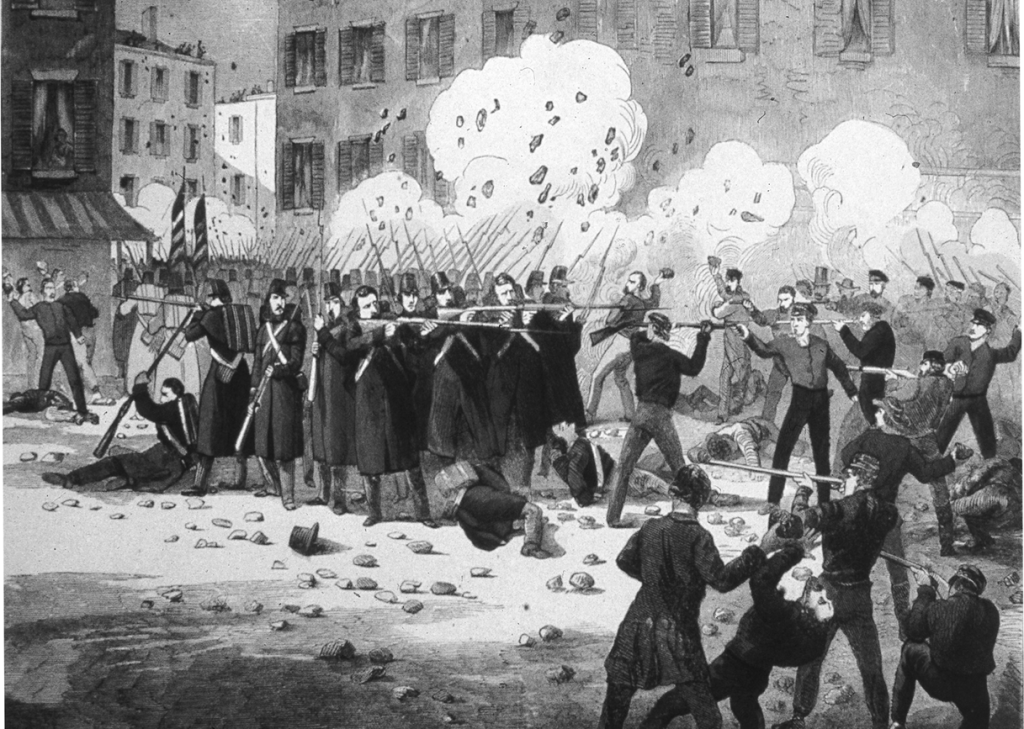
A mere five weeks following Lincoln’s inauguration, South Carolina demanded the surrender of the federal Fort Sumter, in Charleston Harbor, and when the commander refused, the South Carolina militia bombarded the fort. Following its surrender, Lincoln subsequently called for 75,000 troops to rush to Washington to protect the city from Virginia militia massing just across the Potomac River. Northern governors immediately called up their state militias, which traveled by rail to Baltimore, where they changed trains for Washington. On April 19, 1861, a Baltimore mob assaulted a regiment of Massachusetts troops who were passing through the city, leaving several dead. Those men, along with a dozen Baltimoreans, became the first fatalities of the Civil War.
For every Marylander who fled south to join the Confederate Army, three joined the Union Army. Maryland would endure three invasions by the rebels, leading to the battles of Antietam, Gettysburg and Monocacy, along with numerous skirmishes and engagements along its southern border with Virginia. Confederates sabotaged both the Baltimore and Ohio rail lines and the Chesapeake and Ohio Canal, seeking to disrupt commerce between the upper Chesapeake region and the Ohio Valley.
Lincoln’s Emancipation Proclamation of January 1, 1863, went beyond proclaiming freedom for enslaved people in the Confederate states (it exempted those in areas controlled by the Union Army). The Proclamation also called for the creation of what became the United States Bureau of Colored Troops, which began recruiting, enlisting and training Black soldiers to fight in the Union Army. Approximately 190,000 Black soldiers would serve a nation that had enslaved many of them, ultimately helping achieve their own freedom. Maryland contributed 8,700 Black men to service in the army. Political realignment in Maryland during the middle years of the war would lead to a new state constitution that banned slavery in the state, effective on November 1, 1864.
Maryland was in some ways an anomalous slave state. It remained loyal to the Union (as did the slave states of Kentucky, Missouri and Delaware). Many slaveowners, though certainly not all, believed that, as long as slavery was permitted, their livelihoods were best protected were Maryland to remain in the Union–how, after all, would a Confederate Maryland defend its border with Pennsylvania? Or prevent a Union blockade of Baltimore’s port and interdiction of commerce along the Baltimore and Ohio Railroad and the Chesapeake and Ohio Canal? Baltimore’s business community overwhelmingly opposed a Maryland secession. And perhaps most telling, in the election of 1860, more than half (54.2%) of Maryland ballots were cast for the three Unionist candidates. The planter-dominated state legislature, meeting in special session in April-May 1861, refused to call a statewide convention to consider secession. In the autumn of that year, Maryland elected a Unionist as governor.
Five days following the surrender of Robert E. Lee’s Army of Northern Virginia at Appomattox, an angry white supremacist from Maryland assassinated Abraham Lincoln. John Wilkes Booth was on the run for twelve days before being shot to death in a Virginia tobacco barn by a Union cavalry detachment. Booth is buried in a family plot in Baltimore’s Green Mount Cemetery.
Many Americans continue to debate a Civil War caused by the institution of slavery–one need look no further than, as one example, the minutes of South Carolina’s secession convention to see that plain truth. Contention over the merits of Union and Confederate war objectives persisted for decades among veterans’ groups and in memoirs, lecture halls, school textbooks, funeral orations, battlefield markers and cemetery statuary. This “memory industry” remains alive and well in Maryland, even as the southern narrative of the “Lost Cause”–that the Civil War was a noble struggle for liberty and self-determination that had nothing to do with slavery–continues to erode as a wide range of scholarship exposes it as fraudulent. Descendants of those who fought and suffered in that conflict still sip mint juleps on soft summer evenings and debate the consequences of a Confederate Maryland and even a Confederate States of America, debates that will propel the story of the Civil War to the next generation.
 Site Title